By Sujatha Balasubramanian
Navarasa literally means, nine emotions.
According to Indian tradition, the basic emotions in life are divided under nine heads; Shringara– love, Hasya– humour, Karuna– pathos, Roudra– anger, Veera– valor, Bhaya– fear, Bhibhatsa– horror, Vismaya– wonder and Shantah– peacefulness.
Each of the following stories is meant to portray one of the Rasas or emotions.
Shoka
Guru Somdeva looked at Mathangi silently for sometime and then said, “My child, many of the sorrows in this world are born out of delusions.”
Radha finished her lesson at exactly 5 o’clock and rose from the mat with her bag. As she crossed the hall and came out, the lady called the her. “Oh! There you are Mrs. Gopal. May I speak to you for a moment? You know, I am sending my daughter away to Ooty, shortly. She has such a lot to do before she leaves – clothes and things to see to – I really don’t think she will have any more time for her music.” She handed Radha a few notes, discreetly folded over. “I expect this will be your last lesson.”
Radha stood with one foot on the step. She paused for a moment before she took the notes and put them in her bag. “Thank you,” she said quietly, “good-bye,” and walked down without a backward glance.
Even before she came down the last step she heard the voices inside. “Once she used to sing those Meera bhajans wonderfully but now – who wants to learn music that sounds like a mournful dirge all the time?” Radha smiled wryly to herself. Yes, even that had not lasted. How could it, when it was not true? That music into which she had poured her heart, where was it now? Where was the beloved idol of Krishna she had once worshipped? In the attic? Thrown away? She didn’t know. It was at times of stress that one turned to prayer. But how can one pray if one doesn’t believe? All the fervour, the ecstasy had vanished in a moment. And now, she wondered what remained in her that was enduring.
She walked down to the bus stop and stood in the queue. The forty rupees, yes, she knew it would be exactly that, seemed to weigh heavily in her bag. Last week one of her pupils was having trouble with Maths and so the music lessons had to stop and now this one, the last one, was going away and they had given her forty rupees. Why didn’t I ever learn anything useful, she thought wildly, I can’t even earn my living, what about the monthly bills for him?
Her bus was not very crowded and Radha managed to find a seat. She sat there stiffly, trying hard to control her panic, thinking of him, thinking of how it had been before. The bus went through the city and town into the suburbs, a long way down. When it stopped by the toll gates set in the middle of the yellow-coloured walls, Radha got off.
The watchman was on his stool as usual, and nodded to her even before she could produce her card. She entered the courtyard, shivering slightly with apprehension. It was the same… however many times one passed through the gates, there was always the twisting and churning inside one’s stomach. Carefully averting her eyes from the people who were walking in the garden, she hurried in.
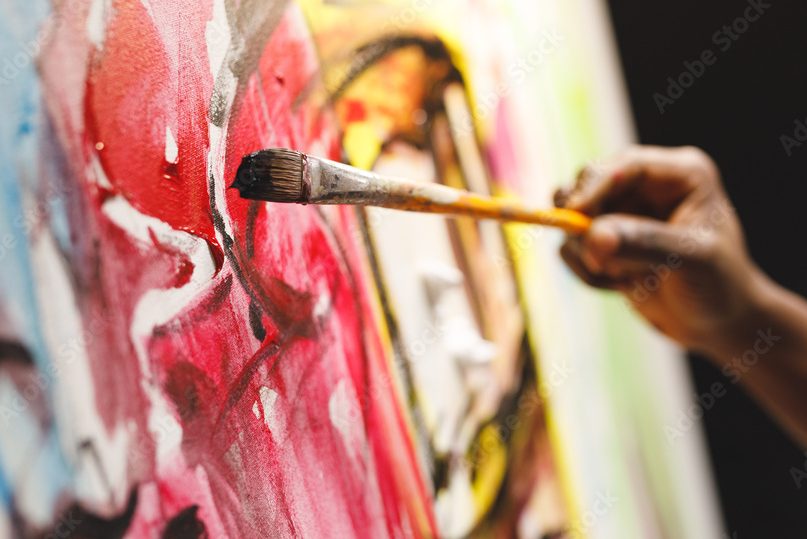
He was sitting in front of the easel, glaring at the paper, hatred shining nakedly in his eyes. He took a thick daub of Gentian blue from the palette in his left hand and drew long, vicious strokes on the paper which was splashed with red. When Radha and the man entered he looked up for an instant and turned back to his painting. Radha glanced at her escort questioningly. “Yes, it is the same,” he whispered, “he is trying to work it out.” She sat down on a chair, clutching her bag tightly in her hand and watching him as he painted, muttering gutturally under his breath.
After a while, he laid the palette and brush aside and turned to Radha. “So it is visiting day again,” he said sitting down on the iron cot. “It is nice of you to come,” he said politely. “May I know your name, madam? Oh! Never mind, I know what you’ve come for. All of you are interested in just one thing, the story of my life. It was the same with the lady last week and although I haven’t met your before, I’m sure that’s what you want, too.” Radha looked down at her feet trying not to let the tears fall. You’ve seen it all before, she told herself, every week for six months, this is no place or time to cry.
“Well, you know I’ve killed her, don’t you?” he began calmly. “It’s next week, the hanging, isn’t it?” he turned to the other man who nodded. “He should know, he’s my jailor,” laughed the man. “It is the blood,” he jumped up and dipped his fingers in red paint and smeared it over the paper. “Hers, you know, Radha’s, my beloved wife’s!” he shouted. “You don’t know her, how can you… and now she is dead.”
He went back to his place at the foot of the bed and stared at the picture. “She was small and dainty and full of laughter and music,” he whispered. “I painted and she sang.” He traced a small, delicate outline on the paper and stood back to admire it for a moment. “But why did she have to say that to me? ‘I love Krishna more than anyone else’ she said and laughed at me. Why did she say it?” he roared, pointing accusingly at Radha. Why, oh why had she ever thought of making a joke of it, a secret of all of her own! Radha tormented herself. It was only an idol, she cried silently to him, it was only wood, but she knew it was too late.
“One always destroys what one loves most,” he said in a rare moment of sobriety. Like I destroyed you, my darling, Radha thought, looking into his vacant eyes, there was nobody but you. “I couldn’t believe it.” he said with astonishment, “the fellow next door whom we rarely saw, my Radha love him more than anyone else?” I didn’t even know his name was Krishna, believe me, implored Radha silently. But he went on, inexorably. “I hit her – on the head – with something or the other.” For a few minutes he stared at the pattern of tiles on the floor and then sighed. “So she is dead, and I shall be dead next week.” You didn’t kill me, cried Radha to herself, it is I who killed you, incarcerated you alive! He remained motionless, his eyes on the floor as the minutes ticked away.
Radha rose obediently when her escort tapped her on the shoulder. She stood at the doorway gazing at the silent figure absorbed in his own thoughts. Her eyes filled and she turned away to follow the man down the corridor.
“I am sorry, Mrs. Gopal,” said the man behind the desk, “there is nothing much I can report. He is just the same, he still thinks he is in jail for murdering you. But, of course, we shall continue to do our best.”
“Does he – paint anymore?” asked Radha hesitantly. The superintendent shook his head. “Nothing of any importance. You saw what he was doing today. He uses up at least a dozen sheets of paper a day but when one thinks of the maestro that he was … ” Sympathy muted his voice.
“Doctor…” Radha faltered, “if anything were to happen to me – would he be looked after?” The bag in her hand felt heavy with the weight of the last forty rupees.
“Of course,” replied the superintendent, “there are provisions for those who have no means of support. But he might not get some of the extras – like the drawing paper… paint.”
Radha took out the money and handed it to him. “Please take care of him for me,” she said simply. “This is all I have for now.” She rose and came out of the office and walked to the bus stand. There she caught a bus which took her to the sea shore. As she walked towards the roaring waves, her bag felt curiously light.
 Stories by Sujatha