By Sujatha Balasubramanian
Navarasa literally means, nine emotions.
According to Indian tradition, the basic emotions in life are divided under nine heads; Shringara– love, Hasya– humour, Karuna– pathos, Roudra– anger, Veera– valor, Bhaya– fear, Bhibhatsa– horror, Vismaya– wonder and Shantah– peacefulness.
Each of the following stories is meant to portray one of the Rasas or emotions.
‘Bhibhatsa’
Somadeva said, “Often, the horror caused by an object is not proportionate to its size.”
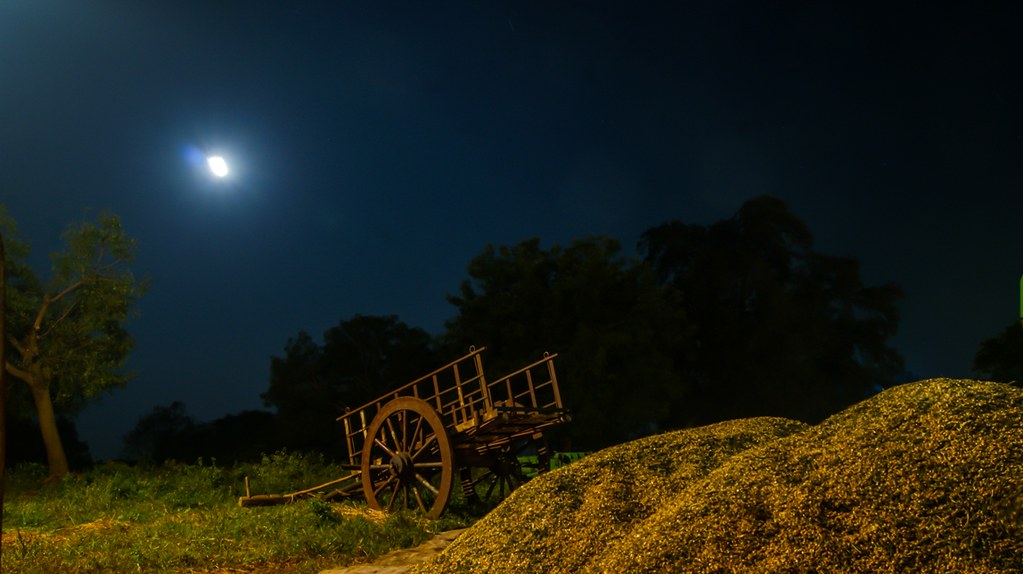
They came for him in the middle of the night. The first thing Chinna knew was the strength of the arms that pinned him down to his cot as a rough gag was thrust into his mouth. There were two of them, two huge, indistinct shapes. They worked silently and ruthlessly, binding his arms and legs with thick rope. One of them tested the knots and then picked him up and slung Chinna’s limp body over his shoulder like a sack of potatoes and walked out of the door. Not a whisper passed between the two and Chinna’s blood chilled at the speedy efficiency with which the whole job was conducted. “These men have done this many times before,” he thought as they dumped him casually into the back of a bullock cart.
At a touch, the bullocks moved along in the darkness, uncannily surefooted and noiseless. Chinna lay on the floor of the cart gagged and bound, wondering where they were taking him. It must have been almost an hour before the cart turned into what appeared to be a forest track. Chinna could sense, more than see, the trees which brushed by the cart. Then it stopped and the men jumped out. He was carried into a large cave and propped up against the rough, stone wall.
Chinna looked around. A crude oil lamp stood in a corner, lighting the place with a ghostly glow. There were signs of habitation in the cave, pots and pans, a stone fireplace and some sticks of wood.
“So, you have brought him!” Chinna turned at the sound of the harsh voice and gasped. A tall form stood at the entrance to the cave, eyeing him with hatred. “Mari!” thought Chinna. “Oh! God! It’s Mari.” Tales of the bandit’s inhuman cruelty and sadism rushed into his mind. His insides churned with fear as Mari approached him.
“Did you think I would let you go free?” The dark, bearded face was full of venom. “After what you did to my daughter?” Chinna lay there helpless, hypnotized by his captor’s gaze. For a moment, Mari was silent. “She was of the woods, innocent and gay, the only ray of light among us,” he said softly, almost to himself. “But you, you devil, you came here with your smart city ways and stole her away from us.” He turned to Chinna savagely. “I wish I had known,” thought Chinna frantically, “that she was the daughter of the most notorious dacoit in the country. I wouldn’t have gone within a mile of her.”
“You and your smooth talk, you enticed my little one to her death,” Mari spat out between clenched teeth. “She believed your promise and left us who had looked after her all her life. I would have forgiven you for taking her away if only she had been happy. But — ” Mari’s face became suffused with passion. “Did you see her tender body swinging in the wind under the neem tree? Did you see the twist of rope biting into her soft neck? No! You ran and ran but did you think this Mari would let you get away?” The dacoit composed his features before he spoke to Chinna again. “When I have finished with you, you will wish that you could have had such a merciful thing as a piece of rope to hang yourself with,” he said with an air of finality. Even the little spark of hope that Chinna had of appealing for mercy died when he looked into that mercilessly cold face.
Mari made a sign to the two men who waiting outside. Chinna struggled ineffectively as they laid him our spreadeagled on the rough floor of the cave and fastened his arms and legs to pegs so that he was unable to move even an inch. His face blanched with horror as one of them forced to open his mouth with a wooden wedge. The other went and returned with a large mud pot.
The dacoit took it in his hand and examined it by the light of the oil lamp. Then he came over to Chinna. Slowly, he poured some of the dark thick stuff down the open mouth. Chinna felt it slide down his throat. It was honey! Carefully, Mari laid a thick trail of the rich, brown honey from the helplessly trussed figure to the dark corners of the cave, crossing over and over again on the floor so that almost the entire cave was covered with streams of the sweet liquid. He poured what was left of it on Chinna’s body and threw the mud pot away. With a last gloating look at his victim, he put out the lamp and went out of the cave.
In the darkness, Chinna waited with horror. Slowly, they came, with the faintest of rustles. Chinna felt the soft touch of the feet on his cheek and screamed – a horrified, ineffective gurgle. Then, they were all over the place, hundreds and thousands of them, their little dry wings rustling and slithering against one another. As one followed the trail of honey down his mouth and into his throat, Chinna strained against the thick rope madly.
They came for him in the morning. He lay as they had left him, his face contorted, eyes staring straight up. The floor was a mess of setting brown. The roaches swarmed over him sluggishly. A big, fat one propped out of the open mouth and lay there, gorged.
 Stories by Sujatha